Problem: Limitations of Manual Tracking

A manufacturing shop relied on Excel spreadsheets and manual processes to track work orders. As the business grew, this approach became difficult to maintain and scale.
Tracking order status required checking multiple files, updating data manually, and relying on handwritten notes from the shop floor. This led to limited visibility, delayed responses to customer inquiries, and increased risk of inconsistent or missing data.
The Solution: A Streamlined Digital Approach
A custom web-based work order management system was implemented to centralize tracking and provide real-time visibility into order progress.
Barcode-Driven Simplicity
Each work order and process step is associated with a barcode. Operators scan at the start and end of each step, allowing the system to capture state transitions automatically and reduce manual data entry.
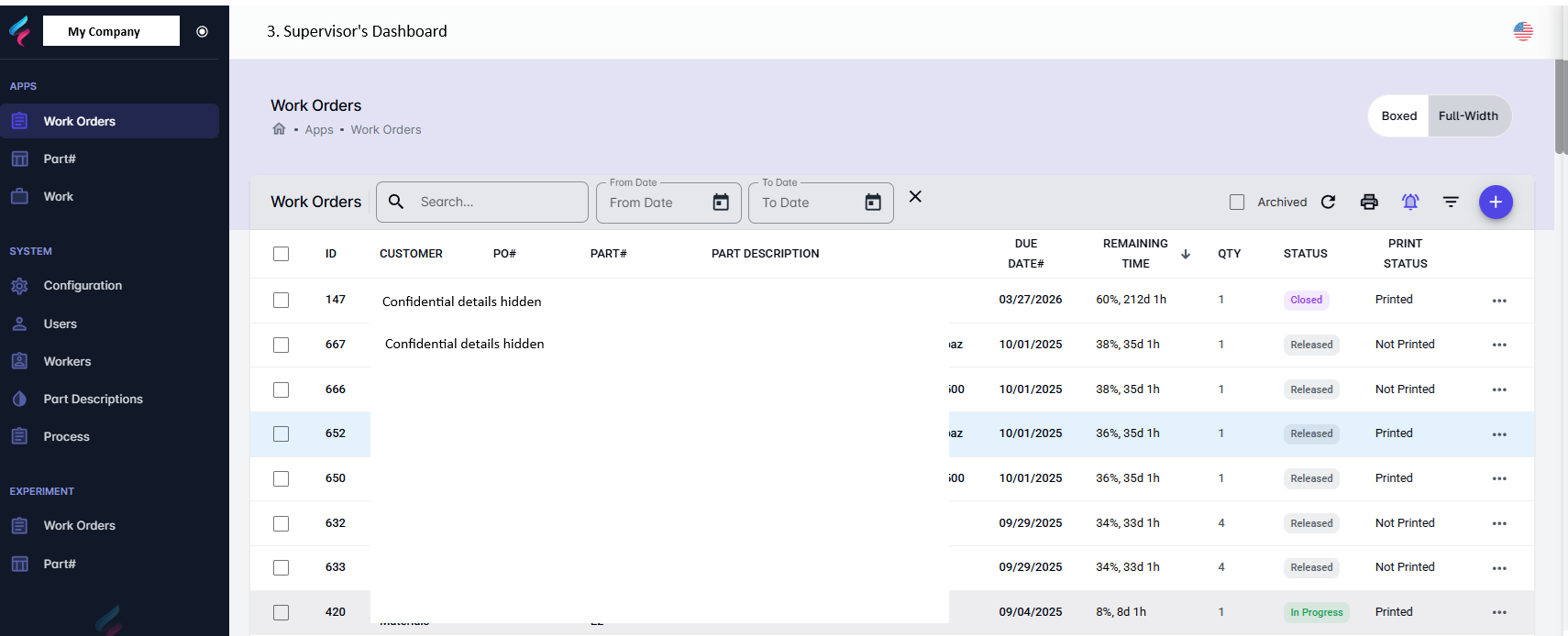
System Overview
The system provides a centralized dashboard for tracking workflow progress:
- Real-time visibility into order status and current processing stage
- Searchable records by customer, part number, or order ID
- Clear indication of progress across workflow steps
- Early identification of delays or incomplete steps
My Role
My focus in this project was on system validation and general project coorindation:
- Validating end-to-end workflows across order lifecycle states
- Testing API behavior and data consistency between backend and UI
- Verifying barcode-driven input flows and state transitions
- Supporting debugging and identifying issues during development and deployment
- Coordinating with the client to gather requirements and validate system behavior against real-world workflows
Results
- Reduced time required to check order status
- Improved visibility in order status and workflow progress
- Reduced risk of lost or untracked orders or activities